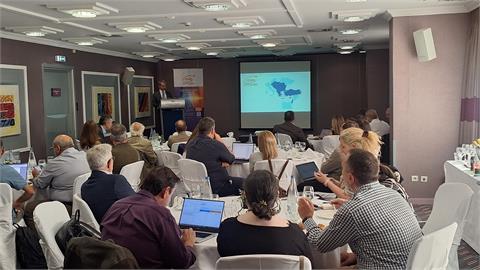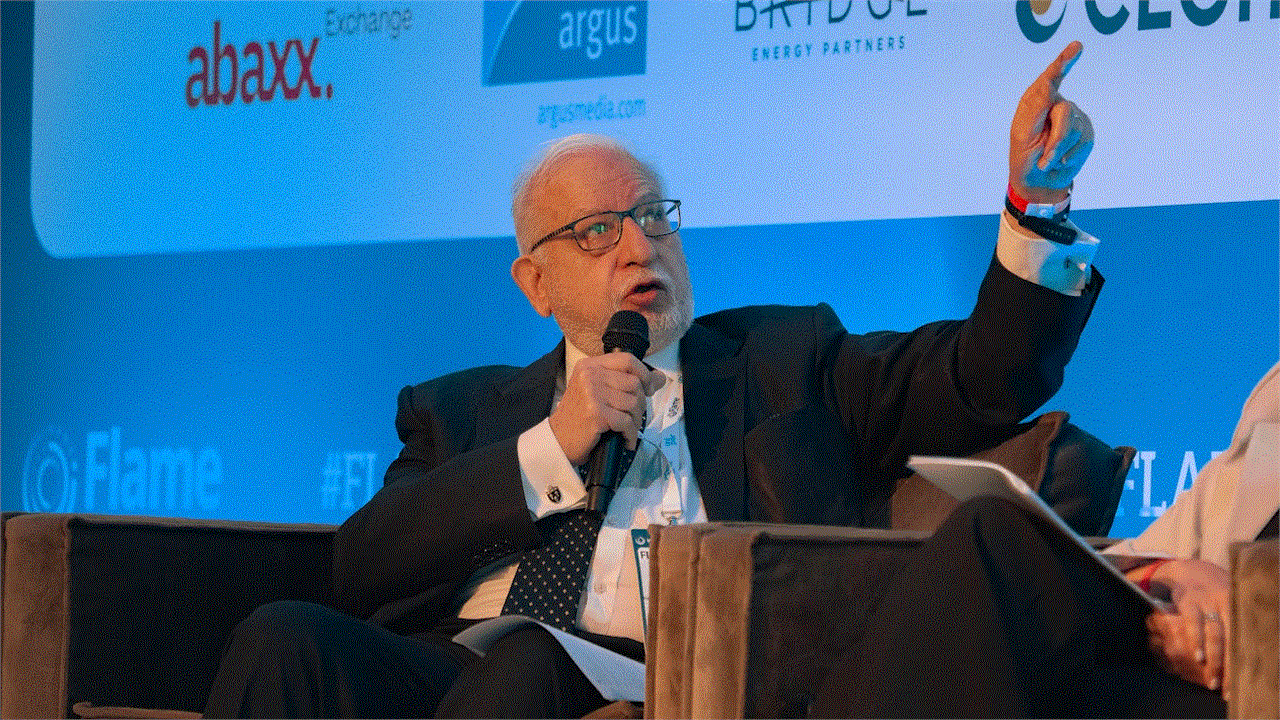
This year’s “Flame” conference, which is considered Europe’s most established gas event for the industry, was held as usual at the Okura Hotel in Amsterdam on May 19-21. The IENE was there as both its Chairman, Costis Stambolis and Visiting Research Fellow Dr. Charles Ellinas, were present with active participation throughout the conference. More specifically Costis Stambolis was one of the invited panelists in the session which examined latest gas developments in the East Mediterranean, which was expertly moderated by Gina Cohen, a well known natural gas analyst based in Israel. Other panel members included Julian Bowden, Senior Visiting Research Fellow, at the Oxford Institute of Energy Studies, Katerina Papalexandri, Chief Financial Officer of Arcius Energy, based in Cairo and Fiona Mullen, Director of Sapienta Economics and Cyprus expert.
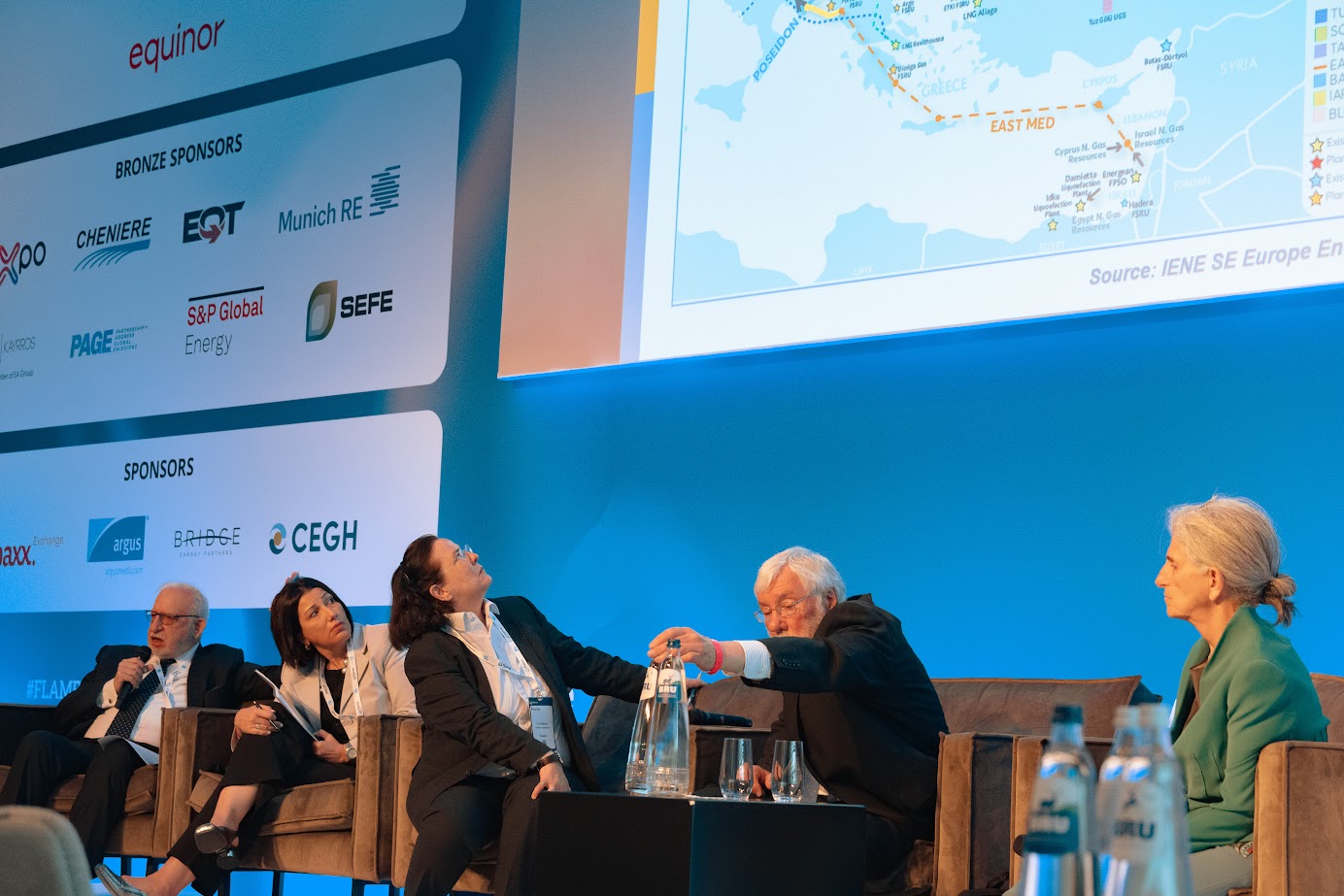
In his intervention Costis Stambolis discussed latest gas developments in the East Mediterranean in view of the current crisis and continuing hostilities in the Gulf area. He contributed the following three points:
A. Gas exploration and production in all countries (Israel, Cyprus, Egypt and Greece) remains absolutely relevant, even for Turkey and Syria.
According to proven reserves so far the region has the potential of becoming a major gas producer over the next decade, but the prospects of feeding large quantities of excess gas to Europe are exaggerated.
Already, we have some serious production in Israel and Egypt and a lot less in Turkiye (some 70-72 bcma between them) while Cyprus has proven reserves of approx. 450 bcm and is getting ready to start production from the Aphrodite field 15 years after its discovery. Greece is going ahead with its first exploratory drilling early in 2027, in Block 2 at the Ionian Sea. Other prospects south of Crete are also actively explored. Greece has the potential of becoming a net gas exporter both via pipeline and LNG. It will take 3 to 8 years.
B. The present crisis has found the region and Greece in particular in the worst possible moment as gas import dependent countries in SE Europe are trying hard to decouple away from Russian gas imports and switch to LNG. Most of imported LNG now comes from the USA
Greece, in 2025 from 7.0 bcma gas imports, 3.3 bcma or 45.8 % came from LNG, a sharp rise compared to 15% before 2022. Turkiye, from 58 bcma of gas imports, 30% was from LNG (18bcma). Croatia, from 3.0 bcma gas supply almost 60% came from LNG imports, the rest was from local production
Overall, we have a 24-26 bcma LNG market in the region and is growing. It could easily reach 30-32 bcma by 2030
C. The Vertical Corridor (VC) is emerging as key via duct for the export of USA LNG to the region. This corridor is made up of existing pipelines which can operate as a single route following elaborate protocol type arrangements between the various transmission operators. (i.e. Greece, Bulgaria, Romania, Hungary, Slovakia, Moldova, Ukraine)
There is a lot of hype at present concerning the role of the VC as very limited volumes so far are being exported through it. Some 1 to 2 bcm during 2025 with products such as Route 1,2 and 3 on offer via monthly or yearly auctions. Seen in context, all the above indicate that gas markets in the region have acquired a new dynamism.
However, the scene is expected to change completely from 2027 as the old Trans Balkan pipeline is getting reverse flow capability and some additional gas pipeline work in Bulgaria gets completed easing bottlenecks in the Bulgartransgaz system. Capacity will increase to some 10 bcma enabling serous gas quantities to move from south to north and capacities will be booked in the conventional manner. Also, transmission tariffs are likely to be reduced by as much as 60% to enable greater accessibility.