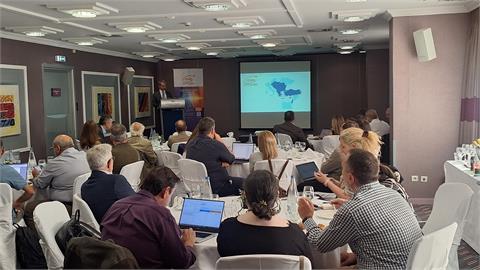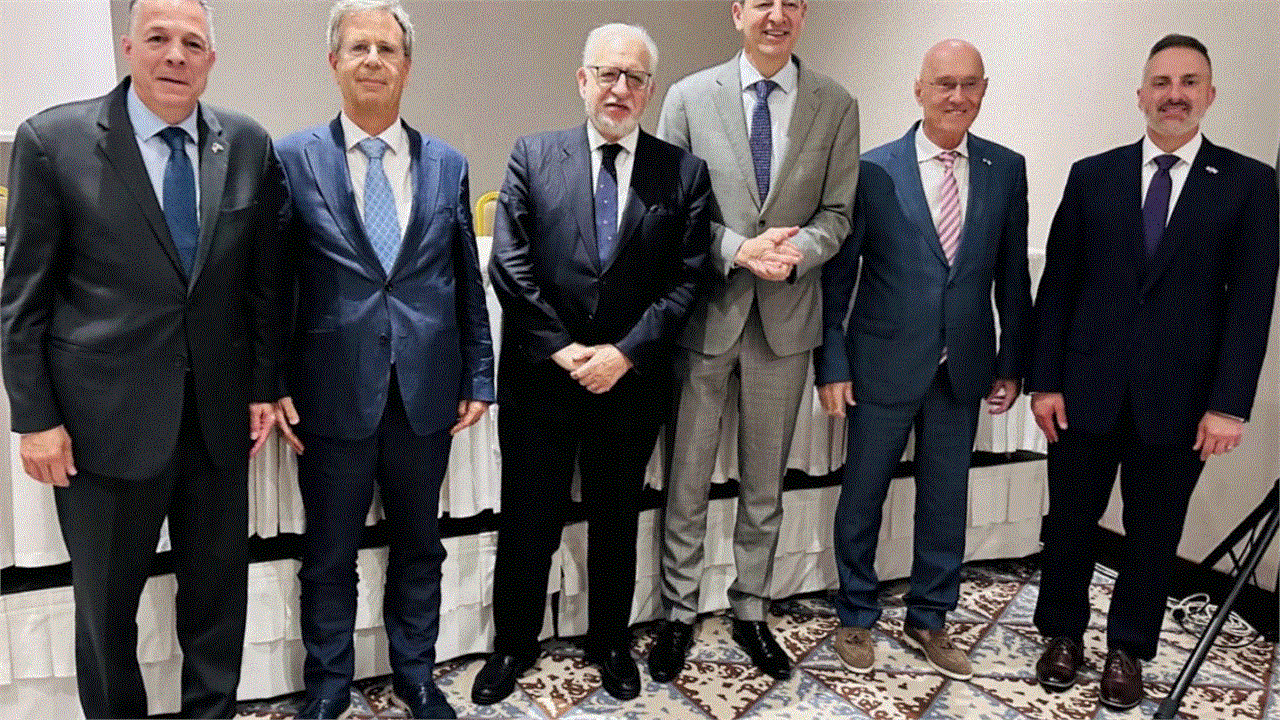
As part of its 30th Anniversary, the World Hellenic Inter-Parliamentary Association (PADEE–WHIA) hosted an international summit entitled “Eastern Mediterranean Energy, Maritime Security and Geopolitics Summit” which was held on Friday, July 24, at the Rodos Palace Hotel in Rhodes, Greece. The event was held under the auspices of the Region of South Aegean brought together legislators of Hellenic heritage, government officials, diplomats, academics, and policy experts to discuss key strategic developments in the Eastern Mediterranean.
PADEE–WHIA is the only global organization bringing together legislators of Hellenic heritage serving in parliaments around the world, with the mission of strengthening cooperation among Hellenic legislators and promoting closer ties with Greece and Cyprus.
The Summit was officially opened by Rhode Island State Senator Leonidas Raptakis from the United States and President of PADEE–WHIA. Welcome addresses were delivered by local officials and by Rear Admiral Georgios Christianos, Director General for Operations, Security and Law Enforcement of the Hellenic Coast Guard at the Ministry of Maritime Affairs and Insular Policy.
In his opening remarks, Sen. Raptakis said: “Disagreements over maritime boundaries should never be settled through coercion, military pressure, or unilateral actions. Instead, they should be resolved through diplomacy, negotiation, or international adjudication,” added Raptakis.
Rear Admiral Christianos stated: “The Hellenic Coast Guard places the highest priority on safeguarding security and stability across the maritime domain of the Southeastern Mediterranean. Close cooperation and strong partnerships with neighboring countries are essential to achieving this shared objective”.
Among the three panels of the Summit the first one was on Maritime Security and was moderated by Admiral (Ret.) Ioannis Egolfopoulos. The second one, on Geopolitics, was moderated by Professor John Nomicos, Director of the Research Institute for European and American Studies (RIEAS), and the third, on Energy, was moderated by Costis Stambolis, Chairman and Executive Director of IENE.
Speaking at the Maritime Security panel, Professor Miltiadis Sarigannidis, of the Aristotle University of Thessaloniki, said that the Aegean archipelago and the Eastern Mediterranean represent a critical test of whether regional security will be governed by international law, the peaceful settlement of disputes, restraint, and judicial adjudication, or by coercion and revisionist faits accompli. He argued that the Greek position offers a coherent and legally defensible framework based on dialogue and good faith, the removal of the casus belli, respect for sovereignty, the protection of international navigation in accordance with UNCLOS, effective deterrence within the limits of international law, cooperation against common maritime threats, and the judicial settlement of maritime delimitation disputes with neighboring states”.
Following that, Admiral (Ret.) Ioannis Egolfopoulos stated “that, as of early 2026, maritime security in the Mediterranean Sea has come under increasing scrutiny. He further noted that the Mediterranean remains a strategic hub for European energy security and global trade, while the boundaries between civilian and military activities continue to become less distinct. This evolving security landscape presents a range of interconnected challenges, such as gray-zone tactics, infrastructure risk and cyber overlap”.
The second panel, which focused on Energy issues and was moderated by Costis Stambolis, covered all different forms of energy and how resources-rich East Mediterranean could enhance European energy security. The panel featured Dimitrios Kardomateas, President and General Manager of the Centre for Renewable Energy Sources & Saving (CRES), Steve Malagari, Pennsylvania State Representative, USA, Basil Zempilas, Leader of the Western Australian Liberal Party and George Kremlis, an internationally recognized expert on energy, climate, and environmental policy.
Speaking at the start of the panel, Costis Stambolis stressed the crucial role of Greece and Cyprus in strengthening European energy security. “This is achieved through the fast-growing contribution of Renewable Energy Sources in the countries’ energy mix, Greece’s expanding regional electricity grid and its new gas corridors to the north. In view of mounting energy supply concerns because of geopolitical instability, East Mediterranean hydrocarbon reserves in the Greece, Cyprus, Israel axis could help enhance Europe’s energy supply. However, in order to be able to exploit the region’s considerable oil and gas reserves cooperation needs to improve between all East Mediterranean countries, which must agree on their Economic Exclusion Zones (EEZ) as foreseen by the International Law of the Sea (UNCLOS) provisions” (the full presentation of C. Stambolis can be seen here).
George Kremlis said that “Greece is emerging as a key regional energy hub and has the potential to become a leading green energy hub, thanks to its landmark energy interconnection projects. These strategic initiatives will not only serve Greece but also benefit other European Union Member States through the Vertical Corridor, among others, while contributing to the future reconstruction of Ukraine. And he added that “Projects such as GREGY, the Great Sea Interconnector, and the EastMed, although supported by the European Commission, require the strongest possible backing from the European Union, as they ultimately serve the EU’s long-term energy security and strategic interests. They also deserve the full support of the United States, as they will help reduce the EU’s dependence on Russian hydrocarbons while ensuring alternative energy sources and diversified energy supply routes.”
Dimitris Kardomateas then stressed the importance of energy independence for the national security and said “that Greece has well diversified energy supplies but the target of full independence will be reached with the development of RES together with energy storage for electricity generation and electrification for the other sectors, with gas and oil having a limited backup role in the end.
This is the vision pictured in the National Energy & Climate Plan of Greece which is under implementation. He also noted the important role of the legislators of diaspora to defend the rights of Greece to develop its energy projects in East Mediterranean, which are obstructed by Turkiye in its broader policy to question our sovereign rights in the region”.
The panel ended with statements concerning energy security issues by Pennsylvania State Representative, Steve Malagari, and by Basil Zempilas, Leader of the Western Australian Liberal Party.