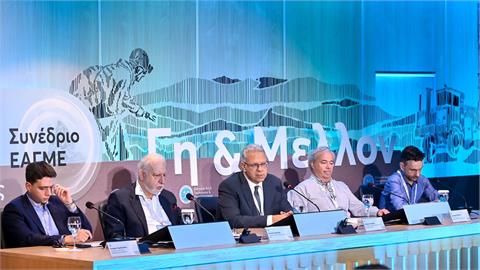
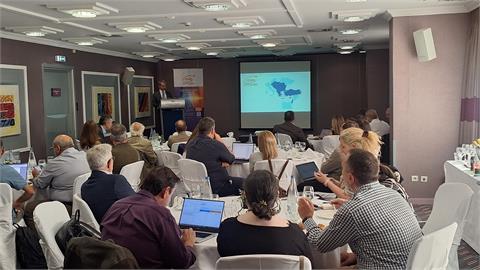
Speaking at a major conference in Athens on July 2, convened by the Hellenic Survey of Geology and Mineral Exploration (HSGME), the Chairman and Executive Director of IENE, Costis Stambolis, strongly argued the case for the urgent utilisation of Greece’s rich geothermal potential for power generation. Participating in the panel discussion, on “Geoenergy: The subterranean power of green transition”, Stambolis focused on the high enthalpy geothermal fields which are to be found within the Aegean volcanic arc and extend along a trajectory of 500 kms length with a 30-40 km width. (see here for presentation)
Some of Greece’s best known and largest geothermal fields are primarily located on the islands of Santorini, Milos and Nisyros, but also spread in several smaller islands including Kimolos, Polyaigos, Giali, Pachia etc. These fields are characterised by high temperatures (280-320 C) and hence have the potential for power generation. From studies carried out over many years by HSGME and others, it has been established that between them the Milos and Nisyros geothermal fields can support power generation stations with an installed capacity of approx. 250 MW or even higher. In view of the fact that the electricity interconnection of the Cyclades Island group to the mainland has already been completed and the interconnection of the Dodecanese Island group is underway, scheduled for operation in 2030, there are no practical obstacles for utilising the power generated by geothermal stations in Milos and Nisyros. The excess capacity to be generated could be easily channeled to the mainland.
Although Greece has 45 well marked high and low enthalpy geothermal fields to be found in different parts of the country, including the Aegean, today there is minimal utilisation. Most applications to date are confined in the agricultural sector in greenhouses. Also, there is a growing market of low enthalpy uses for house heating and cooling. However, on the opposite side of Greek islands in Asia Minor, Turkey has managed to successfully exploit its geothermal fields, located at the very end of the Aegean arc, for power generation. Today, Turkey prides itself in having 1,7 GW of geothermal electricity installed capacity ranking it as the 4th largest geothermal user worldwide.
Summarising, his intervention at the HSGME conference, the Chairman of IENE, underlined the most valuable characteristics of geothermal energy when it comes to power generation, which is none other than the continuous 365/24 operation which makes their contribution to base load power indispensable. In addition, he said, utilising geothermal energy for power generation has minimal environmental impact thanks to modern technology and close loops of heat exchangers used, which prevents the geothermal fluids from being exposed to the environment.
The Case for the Urgent Development of Geothermal Energy in Greece was Strongly Made by IENE’s Chairman at Major Mineral Conference in Athens
Saturday, 04 July 2026