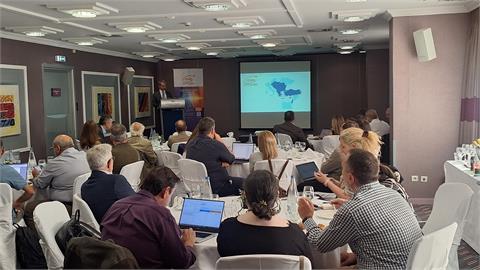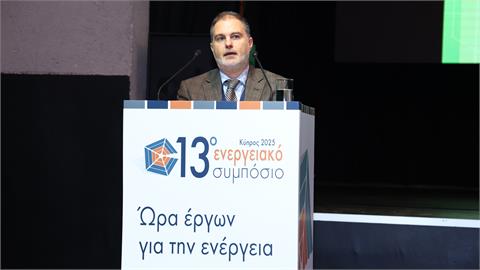
Speaking at the recent 13th Cyprus Energy Symposium which was co-organised by IENE and Nicosia based FMW- Financial Media Wave company, IENE’s Secretary General and leader of the Renewable Energy group of the Institute, Nicolas Sofianos, made a comparison of energy transition priorities and achievements by Greece and Cyprus.
As keynote speaker in the Renewables session of the Symposium he referred to the energy transition in the East Mediterranean and how this is progressing at different speeds influenced by climatic, geographical and economic factors.
As Nicolas Sofianos noted energy transition faces distinct challenges in each country, with Greece and Cyprus at two characteristic but uneven stages of market maturity. Greece’s experience, including both achievements and mistakes over the past fifteen years, provides valuable lessons for Cyprus, which is now at a critical point in effectively integrating Renewable Energy Sources (RES) into a small and isolated electricity system. Comparing the two countries highlights not only differences in technical and regulatory needs but also opportunities for a faster, safer, and more efficient transition for Cyprus, using the Greek experience as a guide to avoid critical mistakes and to strategically plan for the future.
Greece now has a mature and diversified RES market, with around 20 GW of installed capacity (including hydro) supported by a developed regulatory framework, competitive electricity markets, and significant expertise in photovoltaics, wind, and interconnections. In contrast, Cyprus, with approximately 1 GW of mainly solar PV, is at an earlier stage but benefits from high solar potential and significant growth opportunities, particularly in storage and smart grids.
Both countries followed a similar transition path: from long-term FIT contracts to net-metering systems and more recently to net-billing, evolving from small-scale installations toward more competitive markets and auctions. Notably, Cyprus ceased the FIT scheme early (2013) and relied solely on net-metering, resulting in more contracts than Greece but a smaller and more controlled RES penetration. Greece, on the other hand, has already moved to a stage where the market opens further to competition through energy communities, PPAs, and flexibility mechanisms, while Cyprus is following the same path, with small producers needing to adapt to the new electricity market environment.
Despite its greater maturity, Greece faces challenges such as curtailments, network congestion, the need for additional storage, and complex permitting processes. Cyprus, as an isolated system without interconnections, has limited flexibility, high curtailments that are likely to increase, and growing investment risk. In both cases, the increasing penetration of RES puts pressure on networks, though the nature of the challenges differs significantly.
The Greek experience has shown that the mere deployment of RES is insufficient. What is needed is an integrated system with storage, flexibility, reinforced networks, and a stable regulatory framework. Storage and smart grids are critical to reducing curtailments, while transparent auctions, incentives, and the involvement of energy communities enhance acceptance and investment. Strategic network reinforcement and expertise in new technologies are essential pillars. The lesson for Cyprus is clear: a successful transition requires a coherent, stable, and comprehensive framework covering the entire energy market chain.
Today, Cyprus has a particularly significant opportunity: strengthening its market through fully operational competitive markets (Day-Ahead and Balancing, and Intraday in the near future), promoting hybrid projects with storage, and implementing the EuroAsia Interconnector, which will end the island’s energy isolation and enable true RES integration and a more flexible, demand-balanced system. With upgraded networks, storage, and a stable investment framework, Cyprus can build a more resilient and competitive clean energy market in the Eastern Mediterranean.
Overall, Greece’s experience serves as a useful mirror for Cyprus, demonstrating both the potential and the risks of a rapid energy transition without the necessary technical and regulatory alignment. Through targeted investments in storage, flexibility, network upgrades, and market transparency, Cyprus has the potential not only to follow but to surpass the maturity levels achieved by the Greek market at a comparable stage, not quantitatively but qualitatively. The next decade could become a period of stable growth and energy security for the country, provided that strategic choices are coherent, technically sound, and long-term. In this way, Cyprus can secure a leading role in the green transition of the Eastern Mediterranean.