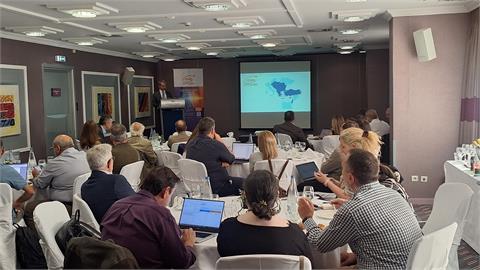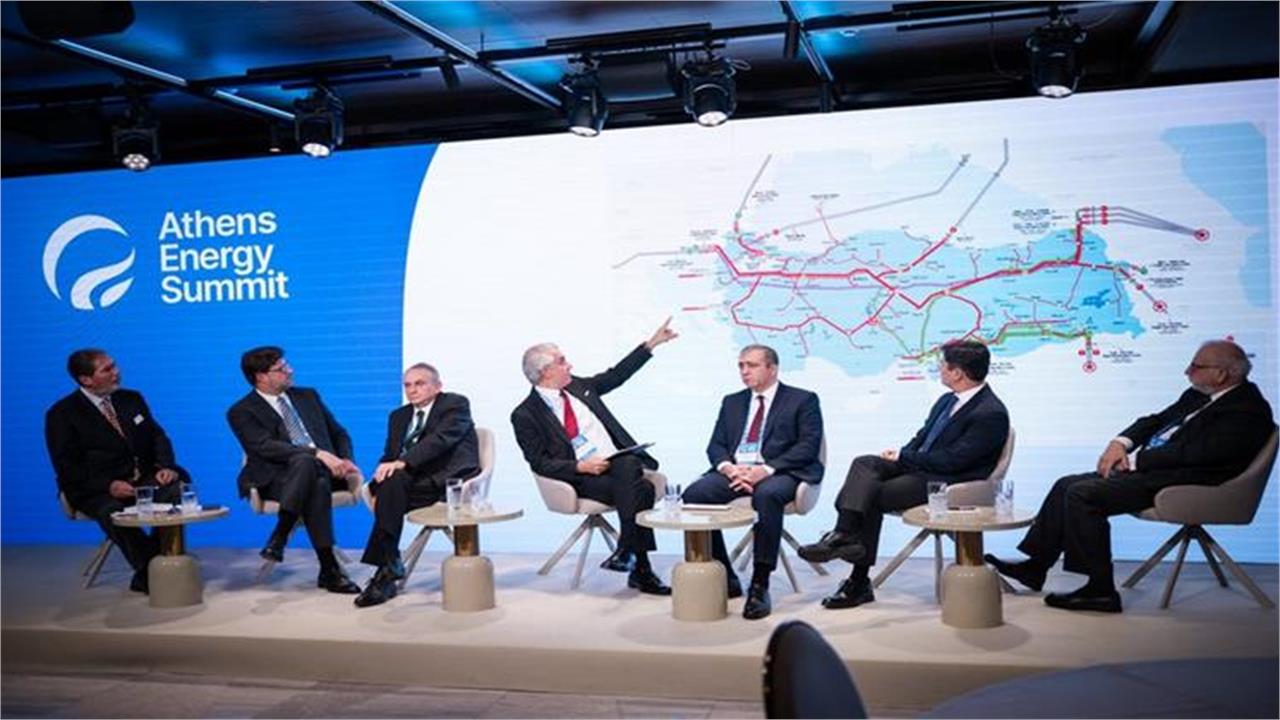
A special session, powered by the Institute of Energy for SE Europe (IENE), on “Energy and Diplomacy Challenges in SE Europe”, concluded this year’s Athens Energy Summit. At the session, an advance presentation of the Institute’s flagship publication, the “South East Europe Energy Outlook 2025/2026”, was delivered by Mr. Costis Stambolis, IENE’s Chairman and Executive Director. The session also included an Ambassadors Forum with the participation of ambassadors of countries of SE Europe and its broader region, under the co-ordination of the Institute’s Diplomatic Advisor, HE Mr. Michael B. Christides, Ambassador (a.h).
IENE’s “SEE Energy Outlook 2025/2026” study, covering the main energy, economic and geopolitical trends in 16 countries of SE Europe, was presented by the Chairman of the Institute, in the context of the Athens Energy Summit, which took place in Aigli Zappeion, downtown Athens, on January 30, 2026, organized by Tsomokos Communications, Greece’s biggest conference organizer.
During the above session, Costis Stambolis mentioned that, in recent years, there has been a convergence in the economies of the countries of the region, both in terms of development and investment, a fact that is also reflected in their energy choices. In the energy mix of these 16 countries, there is an increase in the participation of RES and nuclear energy, as well as oil. Excluding Turkey – which accounts for around 50% of total consumption demand and energy investment in the region – the share of fossil fuels appears to be declining. However, overall oil consumption is increasing, mainly due to rising GDP and the increase in the number of automobiles.
Despite the differences, all countries in the region continue to depend, to a large extent, on oil and natural gas imports. Countries such as Serbia, North Macedonia and Croatia show a particularly high dependence on imported fossil fuels, while Greece, according to the study, has made more progress than the rest of the countries in the region in the direction of decarbonization. At the same time, Kosovo, North Macedonia and Serbia continue to rely heavily on lignite, while Turkey remains a large consumer of fossil fuels.
Particular importance is attached to the steady increase in the penetration of RES in the last decade in all countries in the region, a development that, as noted, is accompanied by the need to strengthen electricity grids, energy storage and regional interconnectivity. In this context, the decisive role of Azerbaijan in the diversification of natural gas supplies was highlighted, as well as the participation of Kazakhstan in the energy flows of the region, thanks to its large oil reserves.
IENE’s Chairman underlined to the need to secure long-term agreements, in a European environment that is moving towards the gradual elimination of natural gas.
At the same time, he referred to IPTO’s plan to export electricity from Greece to Central Europe via the Green Aegean Interconnector, an ambitious project with a strong regional footprint.
The Ambassadors Forum
The Ambassadors Forum that followed included a discussion with the participation of ambassadors of countries of SE Europe and its broader region. Mr. Stambolis announced that the “SEE Energy Outlook 2025/2026” study would be officially presented the following week, on February 5, at the Athens Exchange (ATHEX), sparking a broader dialogue around the challenges of energy and diplomacy in the region. The discussion was moderated by HE Ambassador (a.h.) and Co-Chair, Organizing Committee, Balkans & Black Sea Forum, as well as IENE’s Diplomatic Advisor, Mr. Michael B. Christides.
At the Ambassadors Forum of the “Energy and Diplomacy Challenges in SE Europe” session, countries that either belong to SE Europe or are its energy suppliers had the opportunity to develop, with their highest possible diplomatic representation in Athens, their positions on the region, in light of the leading and highly topical publication of IENE.
HE the Ambassador of Moldova, Mr. Andrey Popov, sent the message that “we must learn the culture of cooperation and put it above temporary gains,” referring to the Vertical Corridor. As he said, “cooperation is the keyword for stability and security in the region”, noting that the Greek Minister of Energy has also repeatedly stressed the need to strengthen regional cooperation. As he emphasized, the next step is to find a way to “make this unique enterprise (the Vertical Corridor) work” and transport gas from Greece to Moldova and Ukraine, also utilizing the enormous underground gas storage capacities that Ukraine has.
Moldova, he said, is no longer dependent on Russian gas. “We buy all our supplies from Europe and specifically from Greece,” he noted, recalling that his country was the first to use the Greece-Bulgaria pipeline (GSI) and the first to buy natural gas from the Alexandroupolis FSRU.
Bulgaria’s interest in participating in the next FSRU now operating in Alexandroupolis by HE the Ambassador of Bulgaria, Mr. Valentin Poriazov. “We would also be interested in participating in the construction of the second FSRU being prepared by the company (Gastrade) that already operates the Alexandroupolis FSRU and in which we have a 20% stake,” he noted. As Mr. Poriazov stressed, the energy issue must be approached with realism, respecting basic European values, as long-term assessments are particularly difficult in the current environment. He underlined that Bulgaria is perhaps the only country currently actively working on the Vertical Corridor, with infrastructure development both on the borders with Greece and Romania, with the aim of doubling the capacity so that neighboring countries can also utilize it.
At the same time, he pointed out that the Greek-Bulgarian electricity networks are in excellent condition, with daily energy exchanges, while noting that his country has reduced its dependence on Russian gas to zero, thanking Azerbaijan, Greece and the other countries in the region for the solidarity they have shown.
“Turkiye will remain a key player in the region,” said, from his part, HE the Ambassador of Turkiye in Greece, Mr. Cagatay Erciyes, regarding energy, while referring to the Vertical Corridor, he emphasized that “alternative corridors can function on a complementary basis”.
He stressed the need to deepen cooperation at the regional and global levels, noting that Turkey can play a decisive role thanks to its geographical location and infrastructure. As he emphasized, the country acts as a bridge between the Caucasus, the Middle East and Asia to Europe, receives natural gas from 22 different countries and has the largest LNG reception network in the region, with five units (three FSRUs and two onshore). At the same time, he emphasized that Turkey is no longer just a transit country, but is developing into a major oil and gas producer following the recent discoveries in the Black Sea.
The need for long-term contracts was highlighted by HE Ambassador of Azerbaijan, Mr. Arif Mammadov, underlining that “long-term contracts are needed, which we do not have at this point and this makes it difficult to invest in new and expanding pipelines”. As he noted, “Europe is now emphasizing on short-term contracts”, which offer flexibility but increase vulnerability and exposure to price increases. Mr. Mammadov stressed that Azerbaijan is a reliable energy supplier for Europe, with its cooperation with the EU having taken an institutional form and covering, in addition to natural gas, RES, the expansion of pipelines and networks. As he said, the country’s natural gas now reaches Germany and Austria, offering real diversification of sources.
On his part, HE the Ambassador of Kazakhstan, Mr. Timur Sultangozin, underlined that his country is one of the largest oil exporters to the European Union and a long-standing reliable and predictable partner for Europe. As he mentioned, Kazakhstan has played an active role in connectivity projects through pipelines and other means of transport, actively supporting the diversification of energy sources.
At the same time, he expressed strong concern about the attacks on energy infrastructure in the Black Sea, noting that such actions will directly affect European consumers. As he stressed, Kazakhstan is ready to cooperate closely with the European Union in the search for legal instruments that will contribute to addressing these threats and ensuring energy security.