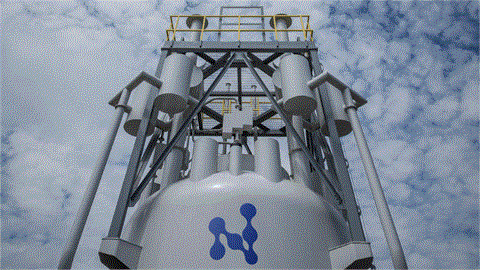
The Institute has just released its latest study (here) which was conducted as part of its long running Nuclear Power in SE Europe (NUPOSEE) research programme. Authored by George Papachristos, an IENE Research Fellow and mechanical engineer specialising on nuclear power generation and industrial processes, the study looks into the potential of Greek industries’ involvement in the global SMR supply chain.
As the author points out, “until now, Greece's public conversation about nuclear energy has been conducted almost entirely at the level of policy principle: whether nuclear power can be part of the country's energy mix, what the risks are, what the costs might be, and whether public opinion would accept it. These are legitimate questions. They are not, however, the questions this report asks.
The question this report asks is narrower, more specific, and in the author's assessment more immediately consequential: what can Greece's existing industrial base contribute to the global SMR supply chain, and what would need to happen for that contribution to materialise into contracted industrial participation? This question has not been answered systematically for Greece. This report is an attempt to answer this key question”.
Small modular reactors are lately entering the Greek public conversation primarily as an energy security question. This report argues that this framing, however understandable, misses the more immediate and commercially significant dimension of what the global SMR industry represents. SMRs are not only a new source of low-carbon baseload power. They are the nucleus of an entirely new industrial ecosystem, one that will generate advanced manufacturing capacity, high-skill employment, export revenue, and technological capability in the countries that position themselves early enough to participate in its construction. Greece has a realistic, near-term opportunity to become a component of the global infrastructure through which SMRs are built, not merely a potential consumer of the power they produce.
This report is the first comprehensive strategic analysis of Greece's SMR supply chain positioning. It was produced at a moment of genuine institutional convergence: on 10 March 2026, the European Commission published its SMR Strategy (COM/2026/117), establishing the most consequential EU nuclear policy framework in a generation, and Prime Minister Mitsotakis delivered his landmark nuclear statement at the 2nd Nuclear Energy Summit in Paris on the same day. The bilateral nuclear technology cooperation declaration signed between Greece and France during President Macron's April 2026 state visit, and the formalisation of the ONEX–Hanwha Ocean cooperation agreement at Elefsina in February 2026, had already signalled industrial-level momentum. On 29 May 2026, the announcement of Project Trident at the US Ambassador's residence in Athens, a trilateral investment framework anchoring the Elefsina shipyard within a US-Greek-Korean industrial alliance, confirmed that three governments have already concluded that this corridor is strategically significant. These events did not create the analysis in this report. They validated its urgency.
The report draws on multi-method research combining systematic desk research, GIS-supported geospatial mapping, sector-by-sector industrial capability assessment, and direct stakeholder consultation. Its purpose is not to recommend whether Greece should build a nuclear power plant. That is a separate question requiring separate preconditions. The purpose is to assess, rigorously and with specificity, what Greece's existing industrial base offers to the global SMR supply chain, how Greece compares to its regional peers, and what policy, institutional, and commercial actions are required to convert latent industrial potential into contracted supply chain participation.