by Gokhan Yardim, ADG Anadolu Consultancy Ltd
Abstract: The long-term natural gas agreement between Israel and Egypt—covering approximately 130 billion cubic meters through 2040—appears to have reshaped the energy dynamics of the Eastern Mediterranean in a more fundamental way than initially anticipated. Cairo’s repeated emphasis that the agreement is “purely commercial” is telling
It suggests that the deal is grounded not in symbolism or geopolitical alignment, but rather in tangible economic parameters such as price predictability, infrastructure utilization, and timing.
Within this context, the gradual decline in Egypt’s domestic gas production combined with rapidly rising internal consumption is transforming the country from merely a transit and liquefaction hub into a de facto regional consumption center. This trend points to an increasingly pronounced gas supply shortfall in Egypt, underscoring that Israeli gas has acquired strategic importance not only for export and LNG re-exports, but also for meeting Egypt’s growing domestic demand. Viewed from this perspective, the economic rationale of the EastMed Pipeline appears increasingly fragile. At the same time, Turkiye—largely because of infrastructure it already has rather than grand new projects—is starting to look like a more central piece of the EU’s gas supply puzzle.
- The EastMed Pipeline: Big Ambitions, Thin Economics
The EastMed Pipeline was conceived as a direct route for offshore Israeli and Cypriot gas to reach Europe via Greece. On paper, it is an impressive project: nearly 1,900 kilometers in length and designed for around 12 bcm per year. In practice, however, it has struggled almost from day one.
Three issues stand out.
First, the cost. Deep-water construction over such distances is expensive, and the technical challenges are not trivial. Second, timing. Even optimistic scenarios push commercial operation to 2028 or later, which matters in a market that has changed rapidly since 2021. Third—and arguably most important—there has never been full clarity on long-term, bankable gas volumes.
The decision to channel a sizable share of Leviathan gas into long-term, fixed-price contracts with Egypt only sharpens this problem. Without guaranteed supply, financing becomes difficult. EastMed still works on a technical level, but commercially it increasingly feels like a solution searching for a problem.
- The Egypt Model: Why LNG Keeps Winning
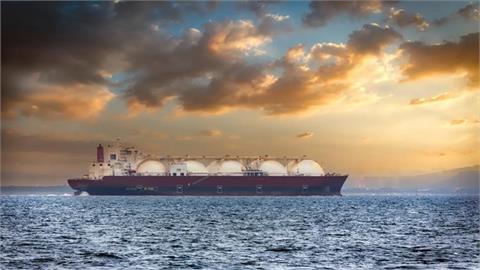
The Israel–Egypt agreement reinforces what many in the industry already suspected: when push comes to shove, the Egypt-based LNG route is simply easier to make work. Existing pipelines connect Israeli fields to Egypt, and the IDKU and Damietta LNG plants are already there.
That setup allows gas to be monetized quickly, shipped to different markets depending on price signals, and redirected if demand shifts. It also avoids locking volumes into a single corridor or customer base. For portfolio players and lenders, this flexibility matters. Compared with a greenfield pipeline stretching across the Mediterranean, the Egyptian LNG option looks less risky and, frankly, more practical.
- Turkiye in the EU Gas Equation: More Than a Transit Country
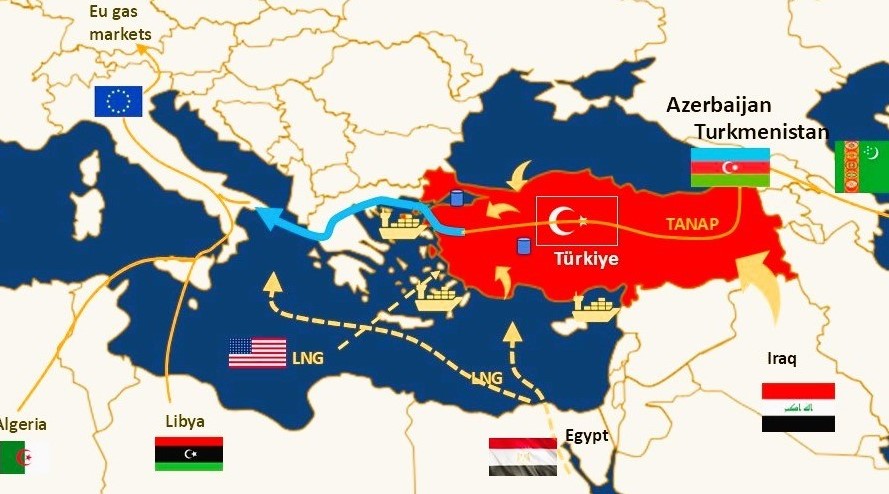
For years, Turkiye was described mainly as a transit route. That description now feels incomplete. What Turkiye actually operates today is a layered gas system with multiple entry points and options.
Pipeline imports arrive from Azerbaijan, Russia, and Iran. LNG comes through terminals at Marmara Ereglisi, Aliaga, Dortyol, and Saros. Storage at Silivri and Tuz Golu adds seasonal and operational flexibility. None of this is theoretical—it is used daily.
From the EU’s perspective, Turkiye’s importance lies less in where the gas originates and more in how smoothly it can be absorbed, balanced, and redirected. For Southeast Europe and the Balkans in particular, access via Turkiye has quietly become essential rather than optional.
- Black Sea Gas: Quietly Shifting the Balance
Turkiye’s production from the Sakarya field in the Black Sea is not, by itself, a game changer for Europe. The volumes are not destined for export. Still, the indirect effects should not be underestimated.
Domestic production reduces Turkiye’s own import needs, which in turn frees up space in pipelines and LNG terminals. That spare capacity can then be used more flexibly, including for westward flows when market conditions allow. In that sense, Black Sea gas strengthens Turkiye’s role as a regional balancing point, even if it never crosses an EU border.
- Turkmen Gas: An Old Idea Back on the Table
Turkmenistan has long been mentioned as a potential supplier to Europe, usually followed by a list of obstacles. Lately, however, the idea of routing Turkmen gas through Azerbaijan and Turkiye has resurfaced with more seriousness.
The appeal is clear. Turkmen gas would diversify supply away from Russia, fit into existing infrastructure such as TANAP, and avoid the cost and political sensitivity of deep-sea projects. It is not a quick fix, and plenty of issues remain, but compared with EastMed, it arguably offers a more scalable and realistic path for expanding the Southern Gas Corridor.
- New LNG Terminals: From Stopgap to Strategy
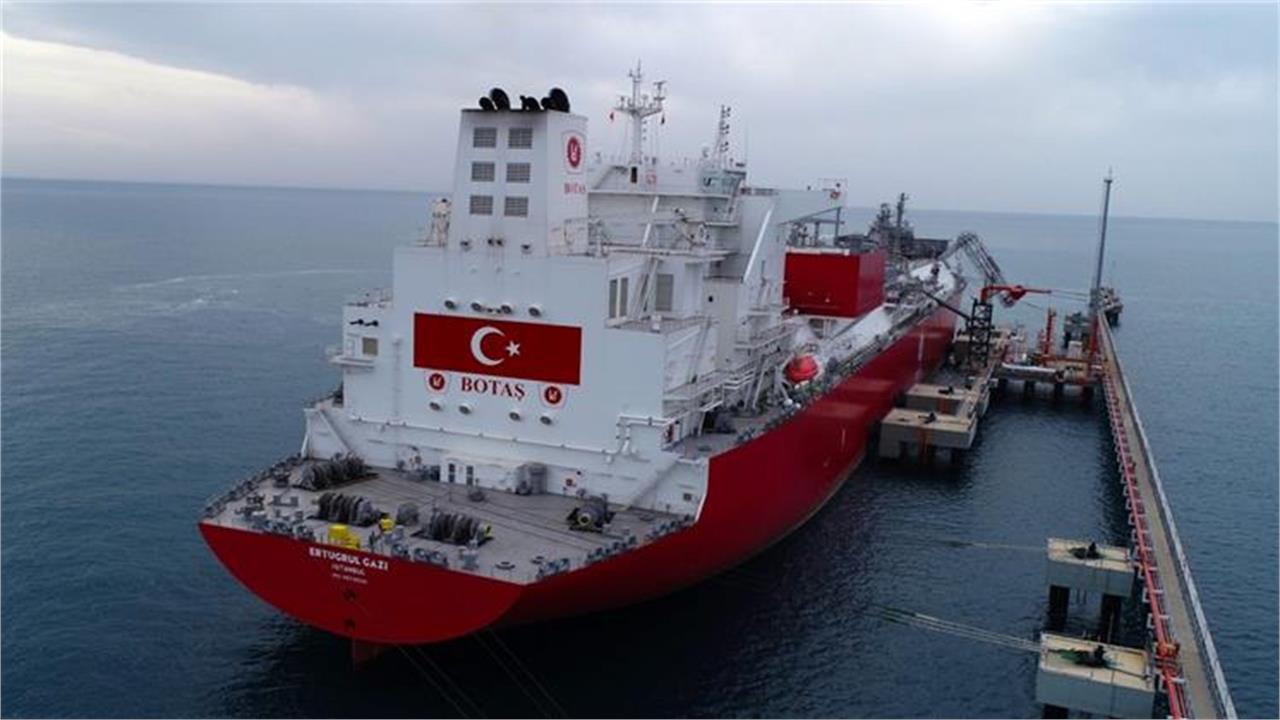
Turkiye’s plans for two additional LNG terminals suggest a shift in mindset. LNG is no longer treated as an emergency substitute or a temporary bridge. It is becoming a permanent part of the system.
Once built, these terminals would push Turkiye’s LNG import capacity into the same range as several leading EU countries. More importantly, they would improve Turkiye’s ability to handle spot cargoes, manage portfolios, and potentially re-export gas during tight periods. The model resembles Egypt’s LNG approach, but with the advantage of being geographically closer to European demand centers.
- Germany’s Policy Signal: Flexibility Matters
Germany’s recent energy choices help explain why this broader shift is happening. Berlin has focused on FSRUs, fast-track LNG terminals, and contracts that leave room for adjustment. There is also a clear emphasis on infrastructure that can later be converted to hydrogen.
This is not just a German story. It reflects a wider EU preference for modular, adaptable systems over single-route mega projects. In that sense, Germany’s approach indirectly validates the models emerging in Turkiye and Egypt, while exposing the rigidity of projects like EastMed.
Conclusion: Turkiye’s Place in Europe’s New Gas Geography
The Israel–Egypt agreement has changed how Eastern Mediterranean gas reaches global markets. Under this new arrangement, Egypt has consolidated its role as the LNG gateway for the region. Turkiye, supported by Black Sea production, potential Turkmen inflows, and expanding LNG capacity, is evolving into one of Europe’s most flexible integration platforms.
What is becoming clearer is that Europe’s gas security framework is being built around systems that are multi-source, adaptable, and convertible over time. Within that framework, Turkiye’s role is no longer marginal. It is increasingly structural—and likely to remain so.
(On Linkedin, December 20, 2025)