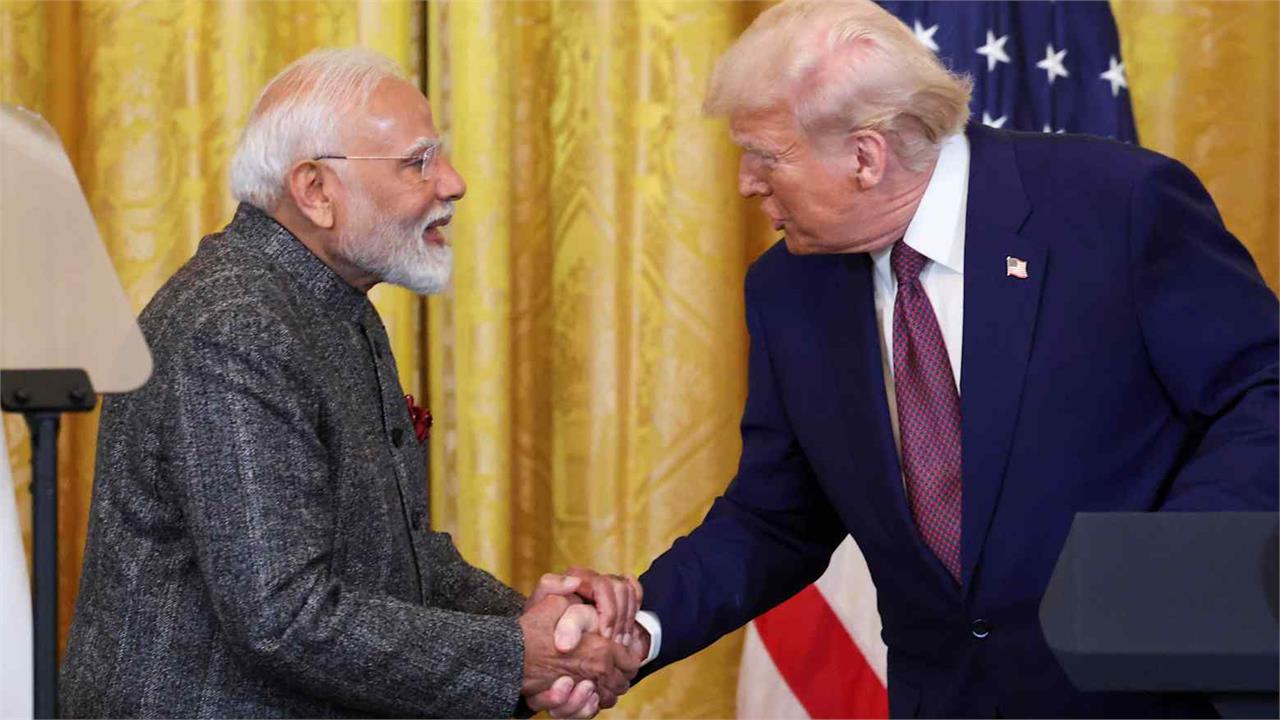
Trump said that India would also start to reduce its import taxes on US goods to zero and buy $500 billion worth of American products. Trump has long had a warm relationship with Modi, only to find it complicated recently by Russia's war in Ukraine and trade disputes.
US President Donald Trump said on Monday that he plans to lower tariffs on goods from India to 18%, from 25%, after Indian Prime Minister Narendra Modi agreed to stop buying Russian oil.
The move comes after months of Trump pressing India to cut its reliance on cheap Russian crude. India has taken advantage of reduced Russian oil prices as much of the world has sought to isolate Moscow for its February 2022 invasion of Ukraine.
Trump said that India would also start to reduce its import taxes on US goods to zero and buy $500 billion worth of American products.
“This will help END THE WAR in Ukraine, which is taking place right now, with thousands of people dying each and every week!” Trump said in a Truth Social post announcing the tariff reduction on India.
Modi posted on X that he was “delighted” by the announced tariff reduction and that Trump's “leadership is vital for global peace, stability, and prosperity.”
“I look forward to working closely with him to take our partnership to unprecedented heights,” Modi said, hailing a "wonderful" phone call with Trump, but made no reference to Trump's assertion about halting Russian oil purchases.
Trump's promises to end war in Ukraine remain just that
India's refusal to stop buying oil from Russia, which Washington says funds Russia's invasion of Ukraine, has been a bone of contention for months as Trump seeks an elusive end to the war.
Trump has struggled to make good on a campaign pledge to quickly end the Russia-Ukraine war and has been reluctant since his return to office to place pressure on Russian President Vladimir Putin. He has simultaneously imposed tariffs without going through Congress to achieve his economic and foreign policy aims.
The announcement of the agreement with India comes as his special envoy, Steve Witkoff, and son-in-law Jared Kushner are expected to hold another round of three-way talks with Russian and Ukrainian officials in Abu Dhabi later this week, aimed at finding an endgame to the war, according to a White House official who requested anonymity to discuss the upcoming meeting.
Trump has voiced that he believes that targeting Russia’s oil revenue is the best way to get Moscow to end its nearly four-year war against Ukraine, a view that dovetails with his devotion to tariffs.
India emerged as a major buyer of Russian oil after the start of the Ukraine war, providing Moscow with a crucial export market as Europe sharply reduced purchases.
In 2024, Russia supplied nearly 36 percent of India's total crude imports, around 1.8 million barrels of discounted oil per day.
As recently as December, Russian President Vladimir Putin during a visit to New Delhi said that he was ready to continue "uninterrupted shipments" of fuel to India despite US pressure.
Tariff threats
In June, Trump announced the United States would impose a 25% tariff on goods from India after his administration felt the country had done too little to narrow its trade surplus with the US and open up its markets to American goods. In August, Trump imposed additional import taxes of 25% on Indian products because of its purchases of Russian oil, putting the combined rate increase at 50%.
With the commitment to stop buying Russian oil and the lower rate, the tariff rate on Indian products could fall to 18%, which is close to the 15% rate charged on goods from the European Union and Japan, among other nations.
A White House official told AFP that an additional 25 percent tariff Trump had slapped on India for its purchase of Russian oil in August would also be dropped.
Historically, India’s relationship with Russia revolves more around defence than energy. Russia provides only a small fraction of India’s oil but the majority of its military hardware.
But India, in the aftermath of the Russian invasion, used the moment to buy discounted Russian oil, allowing it to increase its energy supplies while Russia looked to cut deals to boost its beleaguered economy and keep paying for its brutal war.
EU-India deal
The announced tariff reduction comes days after India and the European Union reached a free trade agreement that could affect as many as 2 billion people after nearly two decades of negotiations. That deal would enable free trade on almost all goods between the EU’s 27 members and India, covering everything from textiles to medicines, and bringing down high import taxes for European wine and cars.
The deal between two of the world’s biggest markets also reflected a desire to reduce dependence on the US after Trump's import tax hikes disrupted established trade flows. While the cost of Trump's tariffs has largely been borne by American businesses and consumers, the taxes can reduce trade volumes among countries.
In recent months, India has accelerated a push to finalise several trade agreements. It signed a deal with Oman in December and concluded talks for a deal with New Zealand.
(euronews.com, February 2, 2026)