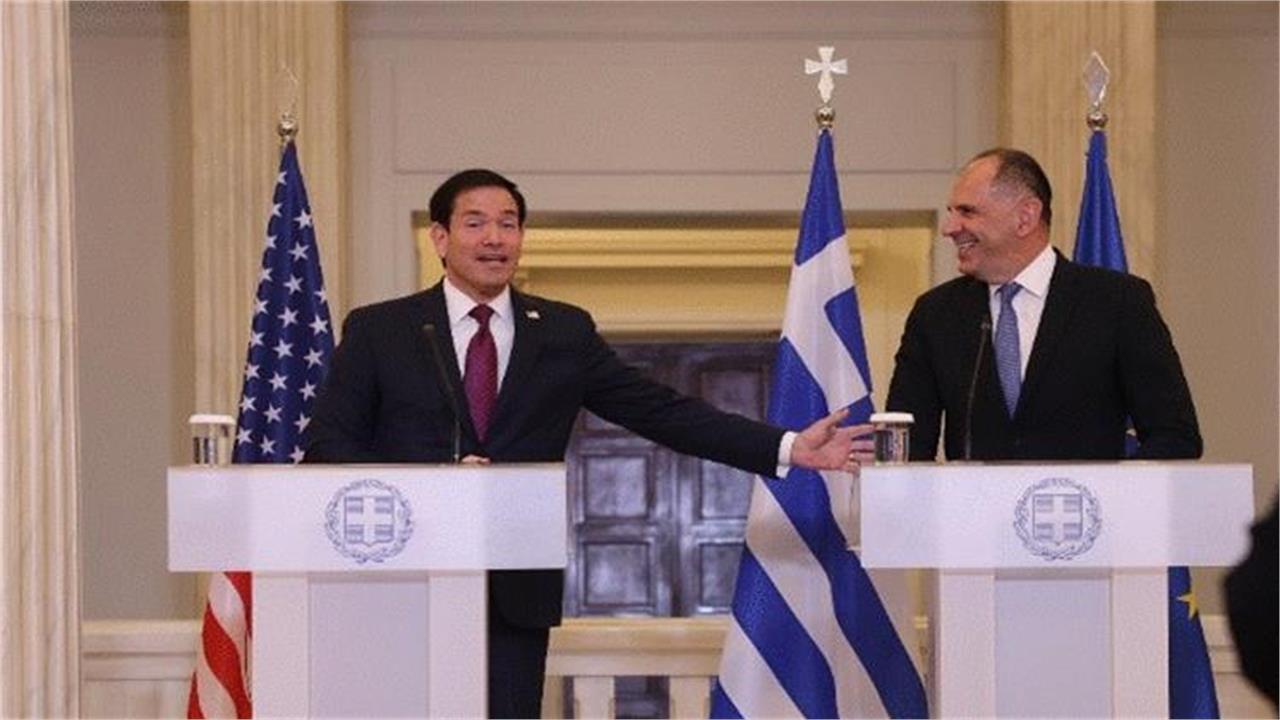
The US Secretary of State to use secret diplomacy to deal with ‘very delicate situation’. Marco Rubio said on Wednesday that Washington is “very committed” to advancing energy projects in Greece and using diplomacy to sort out some “delicate” issues involving Turkey, which he did not name.
The US Secretary of State is visiting Athens as part of the sixth US-Greece ‘strategic dialogue’. His visit coincides with the commemoration of Hamas’s terrorist attack on Israel on 7 October 2023, with Israel being a strong Greek ally in the region.
However, a growing Greek-Turkish spat over maritime disputes has brought the Americans to a point where they need to make a decision.
During a press conference in which Rubio complained about American journalists asking more questions that their Greek colleagues, he was asked how determined the US is to help Greece advance energy projects facing the opposition from neighbouring Turkey.
“We are very committed to the success of these projects,” Rubio replied. However, he noted that some of these projects involve “very sensitive and delicate topics”.
“Some of the things are tied up into very delicate situations involving other countries. I won’t say who, but other countries that are involved in some of the things that are complicating that,” Rubio admitted.
Washington has traditionally maintained a neutral stance on the fragile maritime disputes between Greece and Turkey, as both countries are NATO members. While Donald Trump has repeatedly praised Turkish President Recep Tayyip Erdogan, Rubio described Greece as an “indispensable” NATO ally.
The electric cable
Rubio was referring to the ‘Great Sea Interconnector’, a partly EU-funded project that aims, for the first time, to connect energy-isolated Cyprus to the European electricity grid, as well as establish Israel’s first electricity interconnection with another country.
Turkey claims that the cable infringes on its sovereign maritime rights. A diplomat told Rapporteur last week that French infrastructure investment group Meridiam – which has a majority stake in the project – will need Ankara’s approval to move ahead with the project.
On the other hand, Greece insists that the project does not require Turkey’s permission, but only needs Greek approval.
“We intend to address these issues through private diplomacy outside the realm of press conferences. So let me just leave you with this,” Rubio said.
Although the Greek Foreign Minister Giorgos Gerapetritis did not refer to the issue during the press conference, a diplomatic source in Athens said that “behind closed doors, the issue will be raised”.
(rapporteur.com, October 7, 2026)