Bulgaria has emerged as a European leader in electricity storage, driven by a rapid expansion of solar power, substantial European Union funding and growing private investment.
The country now stores a larger share of its electricity production than any other EU member state, while several neighboring countries are increasingly dependent on imported power.
The development comes after years of political instability. Bulgaria held eight parliamentary elections between 2021 and 2026, making stable government difficult. Yet during the same period, the country adopted the euro on January 1, 2026, and made rapid progress in modernizing its electricity system, particularly through investment in battery storage.
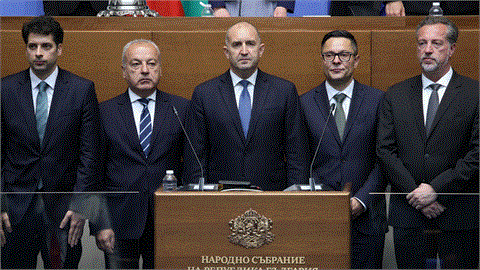
Energy Minister Zhecho Stankov, who has held the post since January 2025, has played a prominent role in the expansion. In the first half of 2026, he inaugurated a 124-megawatt battery installation near Lovech. Built by Renault, the facility can store 496 megawatt-hours and was for a period the largest battery storage project of its kind in the EU. Stankov called it a “first step” toward creating 10 gigawatt-hours of storage capacity, a goal that would further strengthen Bulgaria's role in the regional energy system.
According to the Bulgarian electricity system operator, ESO, installed storage capacity had reached 3,432 megawatts by May 2026. By mid-June, the business weekly Capital estimated the figure at around 4,800 megawatts and 14 gigawatt-hours. That represents a dramatic increase from just two years earlier, when Bulgaria had only about 200 megawatt-hours of installed storage.
The expansion was accelerated by a government program developed soon after Stankov took office. In April 2025, the Energy Ministry announced plans for 82 storage projects with a combined capacity of 9.7 gigawatt-hours, supported by €588 million from European recovery funds. The scheme, known as RESTORE, had been launched in August 2024.
Regulators also moved to limit speculative investment. In September 2024, the Energy and Water Regulatory Commission introduced financial guarantee requirements after amendments to the Energy Act allowed battery facilities to participate independently in the electricity market. The second phase of RESTORE ended in December 2025 with another 31 projects approved, representing more than 4 gigawatt-hours of capacity.
Private investors have provided a significant share of the financing, with private funding roughly twice the amount of public grants. The state-owned National Electricity Company, NEK, has also entered the market. In February 2025, it announced plans to install nearly 300 megawatt-hours of batteries at five of its hydroelectric power plants.
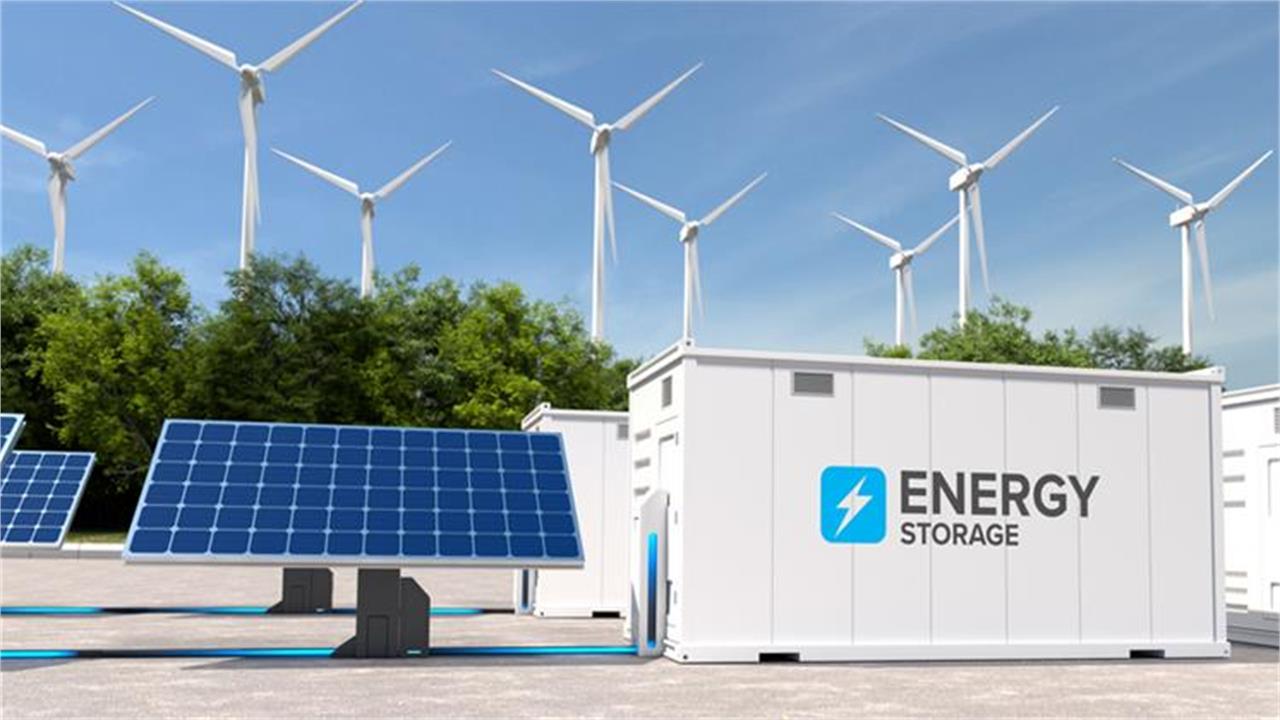
The government's recovery plan also called for about 1.18 gigawatts of solar capacity combined with storage to be operational by March 2026. The approach encouraged developers to build solar farms and batteries together rather than as separate projects. A market study in early 2025 even concluded that, under prevailing conditions, building a standalone solar park in Bulgaria was no longer economically attractive without battery storage.
The rapid growth of solar power has made storage increasingly important. Martin Georgiev of Electrohold estimates that more than 1 terawatt-hour of solar electricity was wasted in Bulgaria in 2025, equivalent to nearly 3% of national consumption, because there was not enough storage capacity to absorb the excess production.
Installed solar capacity exceeded 6.5 gigawatts in early 2026, accounting for more than half of Bulgaria's total electricity generation capacity. At midday, when solar production peaks, electricity prices can fall below zero, while by evening they can climb as high as €250 per megawatt-hour. Nikola Gazdov, chairman of the Association for Production, Storage and Trading of Electricity, said this price pattern is one of the main reasons for the rapid battery expansion. Cheap solar power becomes much more valuable when it can be stored and released when demand and prices are higher.
Batteries are also helping compensate for the loss of older storage capacity. The 864-megawatt Chaira pumped-storage hydropower plant in the Rila Mountains has been offline since April 2022, when a turbine in its fourth unit failed. Full restoration is not expected before mid-2027. For decades, Chaira was one of Bulgaria's principal tools for storing electricity, but batteries are increasingly filling the gap.
The country's electricity system continues to rely on a mixture of technologies. The two reactors at the Kozloduy nuclear power plant generated about 35% of Bulgaria's electricity in 2024, while the plant has used Westinghouse nuclear fuel since May that year. The Maritsa-Iztok complex remains the largest coal-mining region in Southeast Europe.
Bulgaria was a net electricity exporter last year, although only by a relatively small margin. Net exports fell to 1,268 gigawatt-hours in 2024, around six times lower than in 2022, but exports are expected to be considerably higher in 2026.
The situation is markedly different in some neighboring countries. Gabriel Avcaricei, editor of Energonomics, estimates from data provided by Romania's electricity transmission operator Transelectrica that Romania was a net electricity importer during about 72% of 2025. Researcher Balis Marco of RoEM-UBB in Cluj puts the difference between Romania's electricity purchases and sales at around €5 billion for the year. “Accelerating the transition to renewable energy sources could be a solution to both problems,” he said.
Romania had previously been an electricity exporter but became a net importer after 2019. It installed its first 500 megawatts of battery storage in 2025. Hungary is even more reliant on imported electricity, with net imports accounting for 18% of its supply, while almost two-thirds of those imports come from Slovakia. Poland continues to generate 57% of its electricity from coal.
The growing importance of batteries is already changing how regional electricity markets function. Evangelos Gazis of Aurora Energy Research told Capital in July that “batteries are starting to change the way the electricity system operates.” Aurora expects that by 2030 the price of solar electricity will be about 48% below the base electricity price as the expansion of solar capacity pushes down the cost of generation. That growing price difference is expected to make storage investments increasingly attractive.
Aurora estimates that Bulgaria has already contracted more than 14 gigawatt-hours of storage capacity, compared with a 2030 target of 1.28 gigawatts. On that measure, the country has effectively reached its target four years ahead of schedule.
The rapid expansion nevertheless carries risks. Electricity interconnections are becoming congested, opportunities to profit from price differences could diminish, and a significant part of the current investment boom depends on subsidies that will eventually expire.
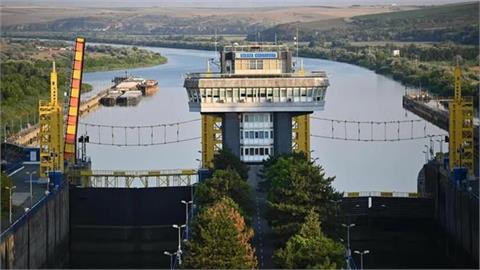
For now, however, Bulgaria's rapid deployment of storage has helped shield it from some of the problems confronting other countries in the region. Romania, where investment in storage has lagged, has urged households and businesses to reduce electricity use during peak hours. The country's low water levels have also forced authorities to take emergency measures to keep its nuclear power plant operating, including sinking stone-filled barges in the Danube to redirect water toward the facility.
Romania is also considering bringing some closed coal-fired power plants back into operation, a move that could draw criticism from the EU and put European funding for its energy transition at risk. Bulgaria, by contrast, has so far avoided those pressures through its rapid expansion of battery storage and solar generation.
(Novinite, August 11, 2026)