by Malcolm Moore
Global annual investment in nuclear power needs to triple to about $250bn if governments want to meet their stated energy goals, the industry’s main lobby group said as it urged banks to channel more private capital into the sector.
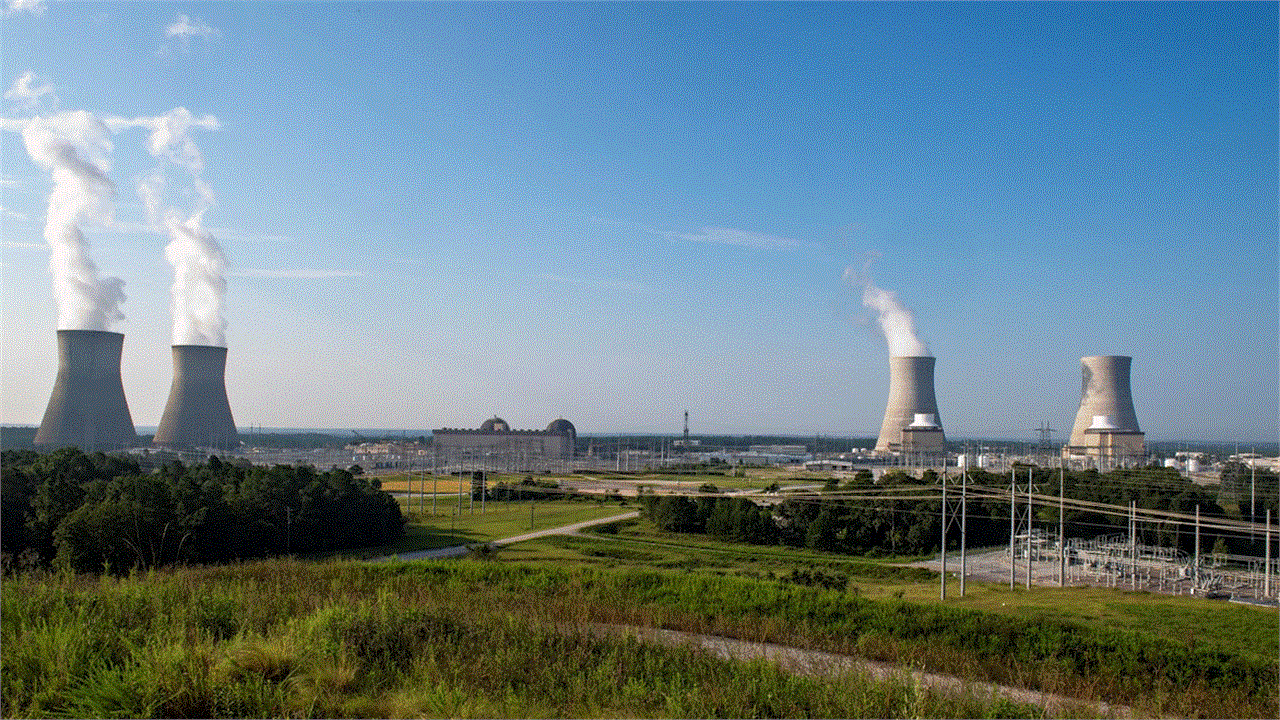
Nuclear power has recently enjoyed a revival as countries around the world seek reliable low-carbon electricity to meet rapidly rising demand.
Countries that had previously shut down nuclear stations, such as Japan and Taiwan, are bringing them back online while German Chancellor Friedrich Merz has said the country’s decision to shut down its plants in 2013 was a “serious strategic error”.
But the industry continues to struggle to attract investment because new plants are expensive, take years to build and carry significant construction and political risks.
“We are seeing an enormous appetite,” said Sama Bilbao y Leon, the director-general of the World Nuclear Association. “We have 50 countries that have actual plans, in black and white, that include nuclear. This is going to require a lot of money, much more than we are investing right now.”
But Bilbao y Leon argued the sums were not excessive when set against spending elsewhere in the energy system. The International Energy Agency expects about $665bn to be invested in renewable power globally this year, while spending on oil, gas and coal is forecast to reach $1.2tn.
The WNA calculated the required nuclear investment by examining countries’ targets and estimating the cost of delivering them in each region.
In 2025 prices, it expects spending to peak between 2041 and 2045. About $1tn would be directed towards large nuclear plants during that period, with a further $450bn allocated to small modular reactors (SMRs). Another $84bn would be spent extending the lives of existing reactors.
Currently, countries around the world collectively spend some $75bn a year on nuclear projects. Roughly 80 reactors are under construction, the vast majority in China, India, South Korea and Russia.
“When we talk to the finance community they tell us the capital is there,” said Bilbao y Leon. “We are seeing capital flowing to other parts of the energy ecosystem.”
Luba Kotzeva, former European co-head of infrastructure at Deutsche Bank who now runs energy consultancy Etara, said countries had to think in terms of building nuclear fleets rather than individual projects to bring costs down and draw in private finance.
“To date, for more than a decade, everything has been state-funded. Now we are seeing fleet orders come through in the US and with the Rolls-Royce SMRs in the UK, Sweden and the Czech Republic. And a number of nuclear developers are emerging,” she said.
Two years ago, some of the world’s largest banks and financiers, including Bank of America, Barclays, BNP Paribas, Citi, Goldman Sachs and Morgan Stanley, pledged to increase their support for nuclear power and help reduce financing costs, which can account for a large share of the total cost of a new plant.
Banks have traditionally been wary of the sector because of the complexity of financing projects, the risks of delays and cost overruns, and uncertainty over whether nuclear power meets environmental, social and governance criteria. In the UK, the start-up of Hinkley Point C has been pushed back again to 2030, five years after it was initially due to come online, and its cost estimate has nearly doubled.
Last year, the World Bank ended its decades-long ban on financing nuclear energy, offering to support efforts to extend the life of existing nuclear reactors and to upgrade grids and infrastructure.
Bilbao y Leon said the industry had been meeting financiers every few months to improve their understanding of nuclear projects. Other multilateral development banks were also considering how they could support the sector, for example by financing reactor construction or supporting the creation of regulators, she added.
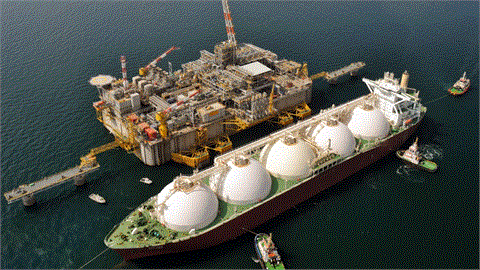
Bilbao y Leon compared the nuclear revival with the early development of the liquefied natural gas and offshore wind industries.
“There were moments of uncertainty when financiers were not really sure how this was going to work,” she said. “Once you go through the process and understand how it works, you can become comfortable and standardise the projects.”
“Right now, for nuclear, we often need to put together a first-of-a-kind financial framework every time.”
Although developers are pursuing a large number of competing small modular reactor technologies, there are relatively few large reactor designs. Bilbao y Leon said that should make it easier to standardise the financing and construction of conventional nuclear plants.
She cited the UK’s Sizewell C project as a model for combining public and private investment and said Sweden, Canada, the Netherlands and Romania had also developed financing structures that could be replicated elsewhere.
(Financial Times, July 29, 2026)